
Executive summary
Friday was a relief session, not a recovery: SPY added 0.31% to $735.29 and QQQ rose 1.40% to $656.10 after Thursday's 4.41% and 6.49% losses, yet fewer than half the stocks in either fund rose (36.6% of S&P 500 members, 46.5% of Nasdaq-100 members) and the median stock fell in both. The buying concentrated in the names hit hardest this week — our 30-name AI basket had 25 of 30 up with a median gain of 2.75% — while Thursday's defensive winners gave ground and both funds closed well off their intraday highs. SPY sits 0.7% above its 200-day average with 55.8% of its members still above theirs, so the broad market is bent, not broken; QQQ, 13.6% below its October 6 peak and under all three of its moving averages, is where the damage lives. Our stance into next week is wait-and-see — not yet a confirmed dip, not yet a broken market — with CPI on Tuesday and NVIDIA on the 17th as the tests.
Section by section
Pulse: a green day with a red majority
SPY's tiles read +0.31% with 36.6% of members advancing, 59.8% / 61.6% / 55.8% above their 20-, 50- and 200-day averages, and median relative volume of 0.99x on the 329 names with usable history (recent volumes may still be revised). QQQ is weaker underneath a stronger headline: +1.40%, 46.5% advancing, only 39.6% / 46.5% / 42.4% above the same averages, 16 oversold names against 4 overbought. A fund that rises while most of its members fall is a cap-weighted bounce; the S&P's internals are in visibly better shape than the Nasdaq-100's.


The session: buyers showed up, then left
SPY opened at $734.82, reached $742.21 and closed at $735.29 — 0.93% below its high and six basis points above its open. QQQ opened at $658.35, reached $664.52 and closed at $656.10, below its open and 1.27% off its high. By our arithmetic QQQ recovered about a fifth of Thursday's point loss and SPY less than a tenth, and a wire wrap reported the S&P 500 down 2.7% and the Nasdaq 3.4% for the week. A morning rally that fades into the close says demand was real but shallow.
Distribution and breadth: a long right tail over a heavy left body
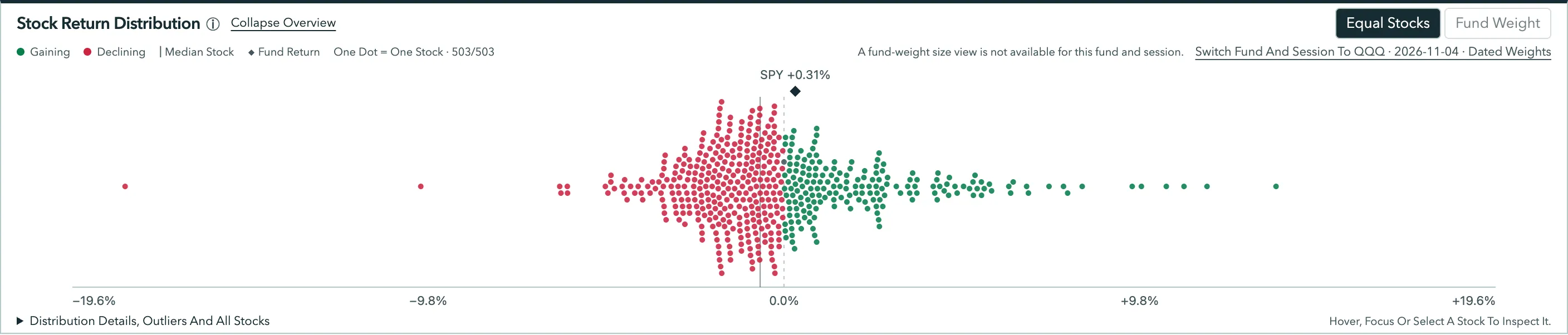
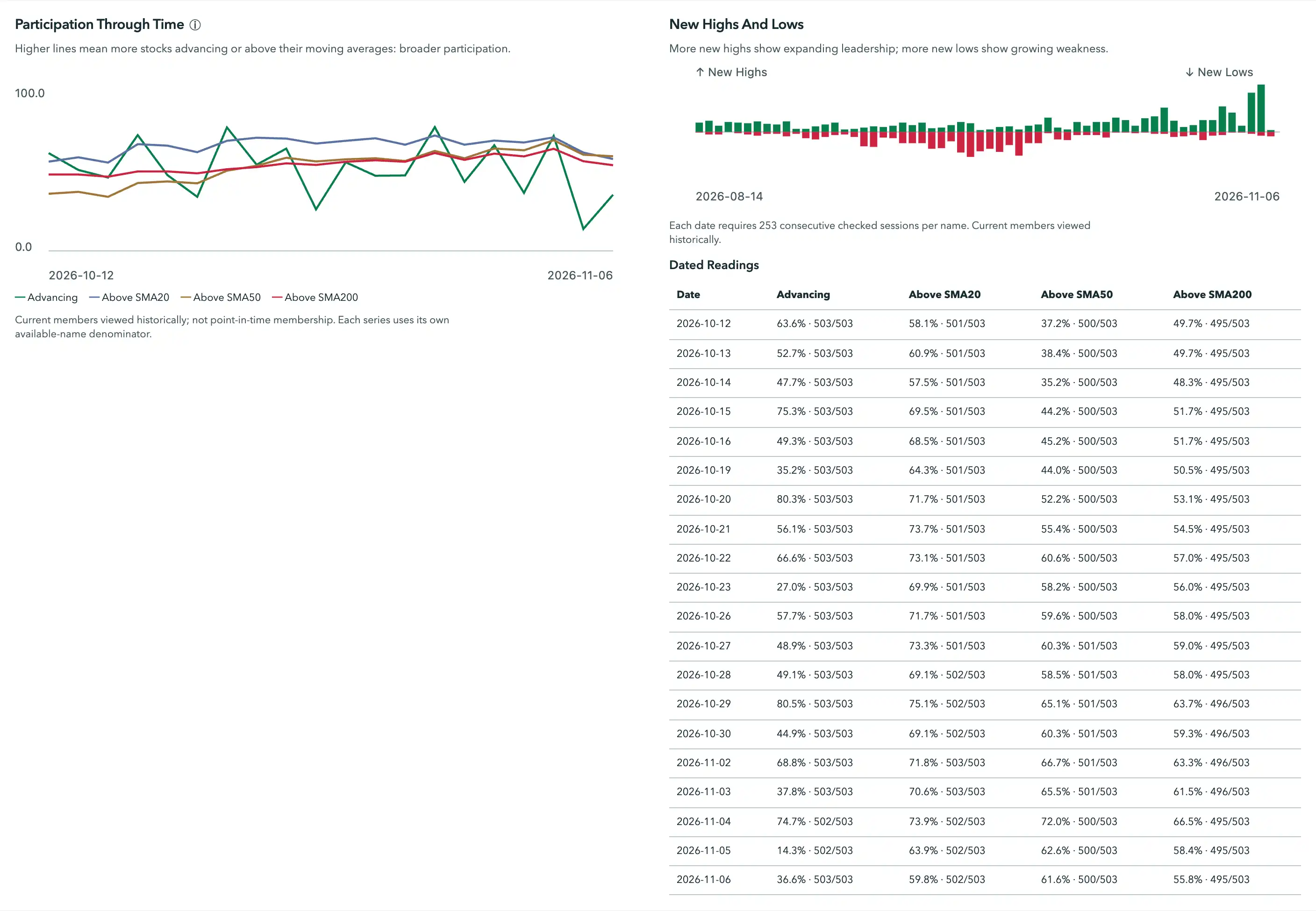
The dot chart shows a dense red cluster just left of zero (median S&P stock -0.66%) and a long green tail of double-digit winners that lifted the fund to +0.31%; one-session dispersion across S&P members was 2.78 percentage points, the 84th percentile of the past year. The erosion matters more than the bounce: the share of S&P stocks above their 200-day went 66.5% on Nov 4, 58.4% on Nov 5, 55.8% on Nov 6, and new highs were 3 against 7 new lows. In our view dispersion this wide marks a market in transition; below 50% above the 200-day, most S&P stocks would have lost their long-term trend.
Leaders and laggards: chips and AI-adjacent names bounced hardest
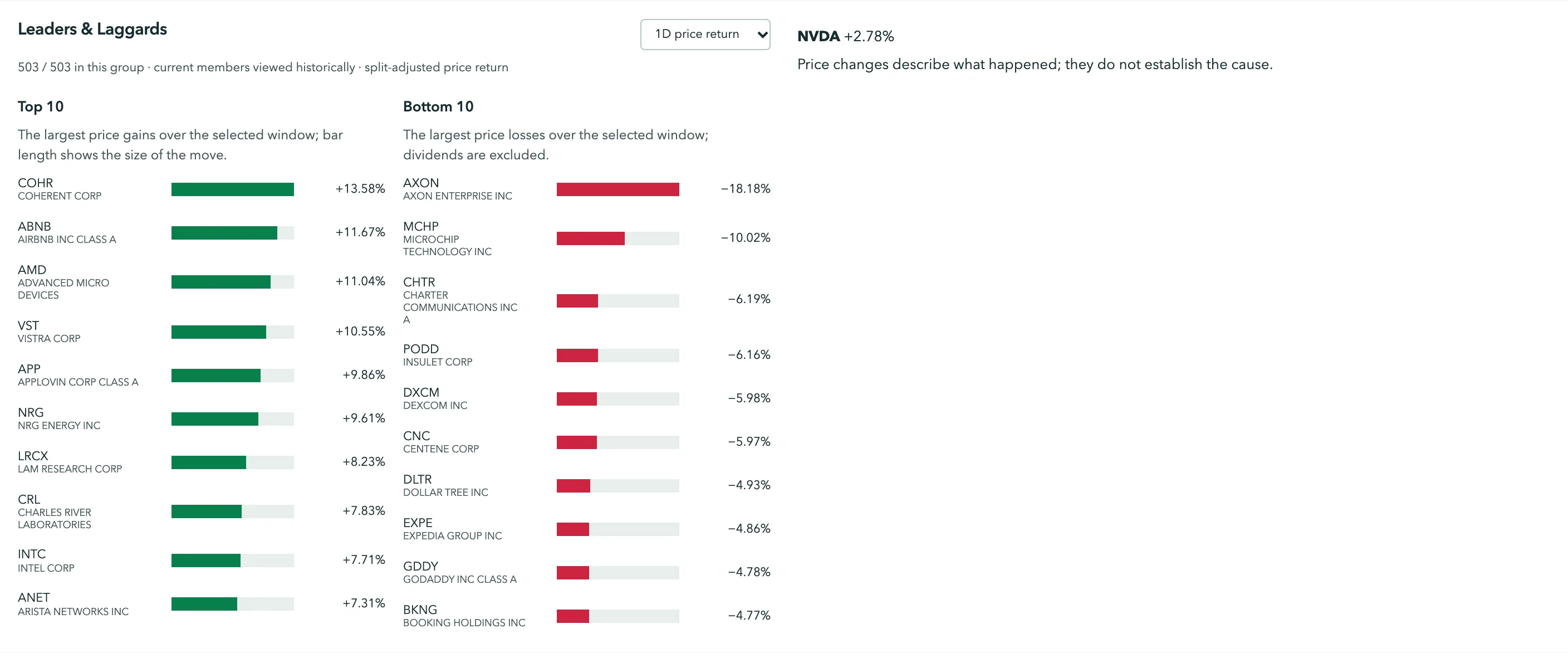
Coherent +13.58%, Airbnb +11.67%, AMD +11.04%, Vistra +10.55% and AppLovin +9.86% topped the S&P; NVIDIA rose 2.78%. AppLovin extended Thursday's +31.04% gain, while AMD — among Thursday's five worst at -17.26% — remains roughly 8% below Wednesday's close by our arithmetic. The largest declines were Axon -18.18%, Microchip -10.02%, Charter -6.19%, Insulet -6.16% and Dexcom -5.98%, single-name moves whose causes we have not verified. Rebounds led by the most oversold names are normal after a 4% down day and say little until they broaden.
Sectors: a straight swap
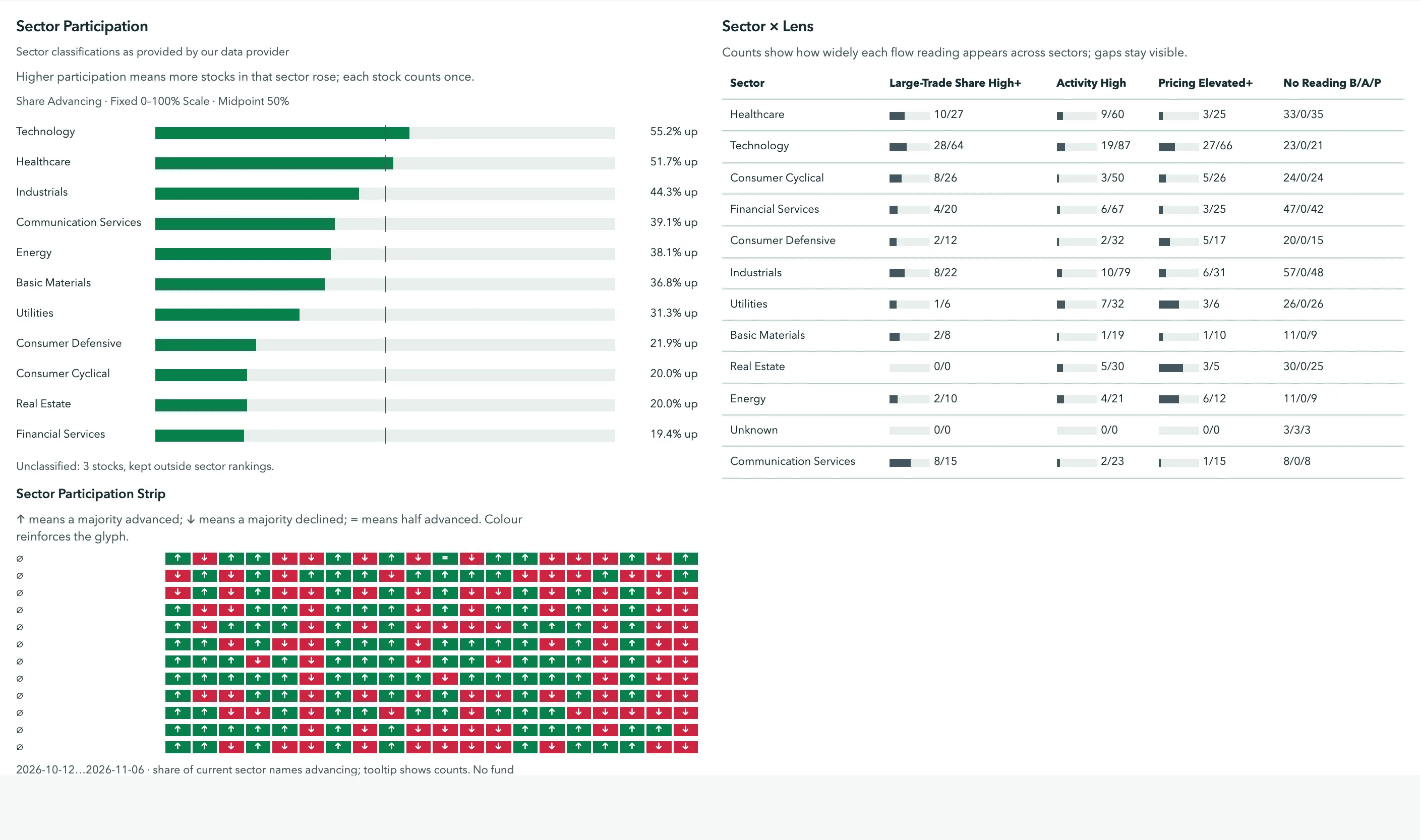
Only two S&P sectors had a majority of members advancing: Technology (median +0.48%, 55.2% up) and Healthcare (+0.10%, 51.7%). Thursday's three best sectors (Utilities, Consumer Defensive, Real Estate) became Friday's losers alongside the consumer and financial groups: Consumer Defensive -1.46% (21.9% up), Consumer Cyclical -1.07% (20.0%), Financial Services -0.97% (19.4%), Utilities -0.94%, Real Estate -0.69%. That is rotation back toward risk, but one day of it.
Momentum: oversold, and starting to lift
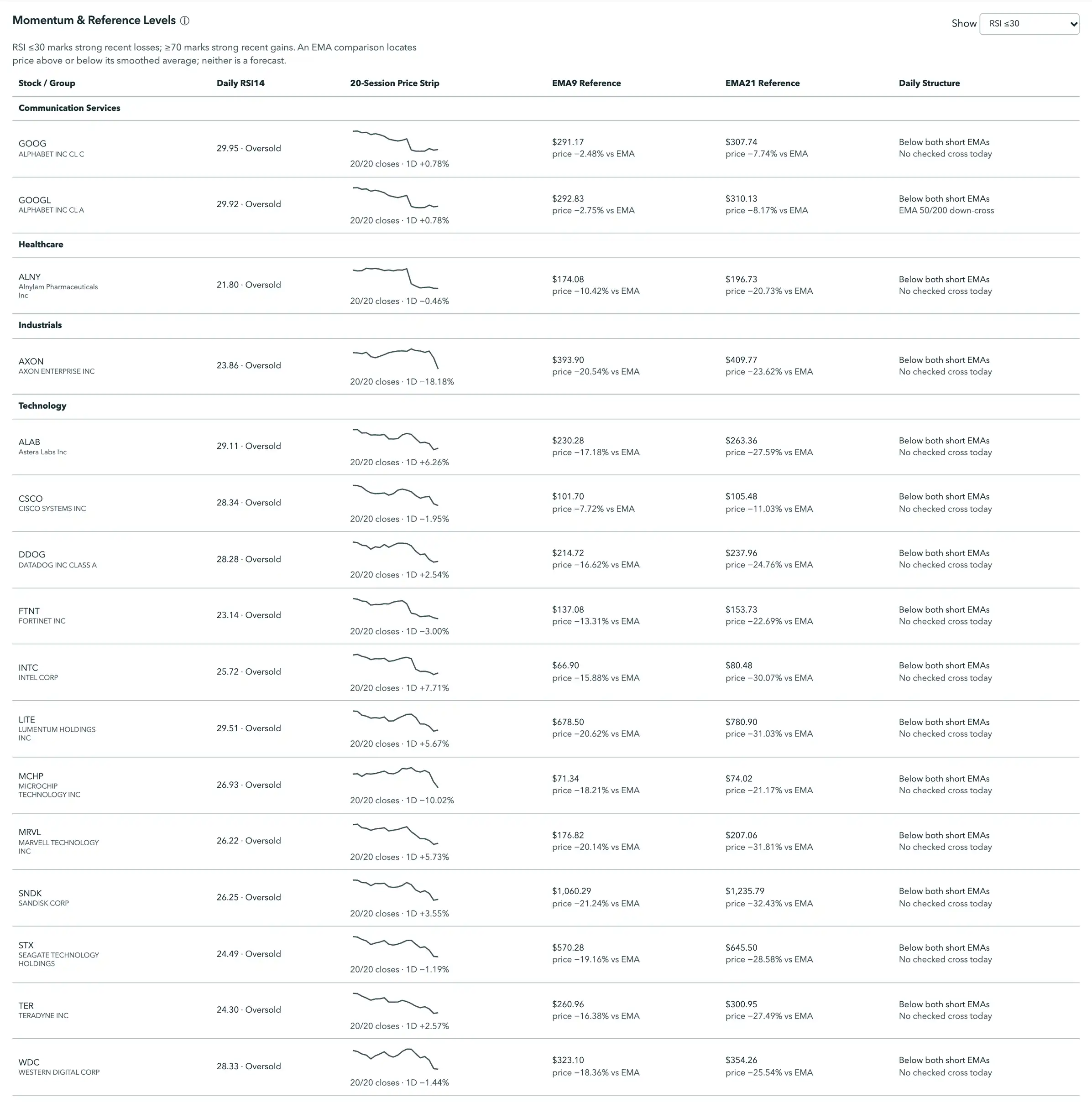
SPY's 14-day RSI rose to 35.1 from 33.5 and QQQ's to 31.4 from 26.9, out of the oversold zone; the oversold count among S&P members fell to 26 from 43. QQQ's 16 oversold names read like a map of this correction — Alphabet (29.95), Cisco 28.34, Intel 25.72, Marvell 26.22, Sandisk 26.25 — and while Intel and Marvell bounced Friday, both still sit roughly 30% below their 21-day averages. Oversold is a condition, not a signal; what would matter is these names holding Thursday's lows for a week while RSI climbs back through the 40s.
Holding Contributions (QQQ): a handful of chips inside a tech-wide rebound
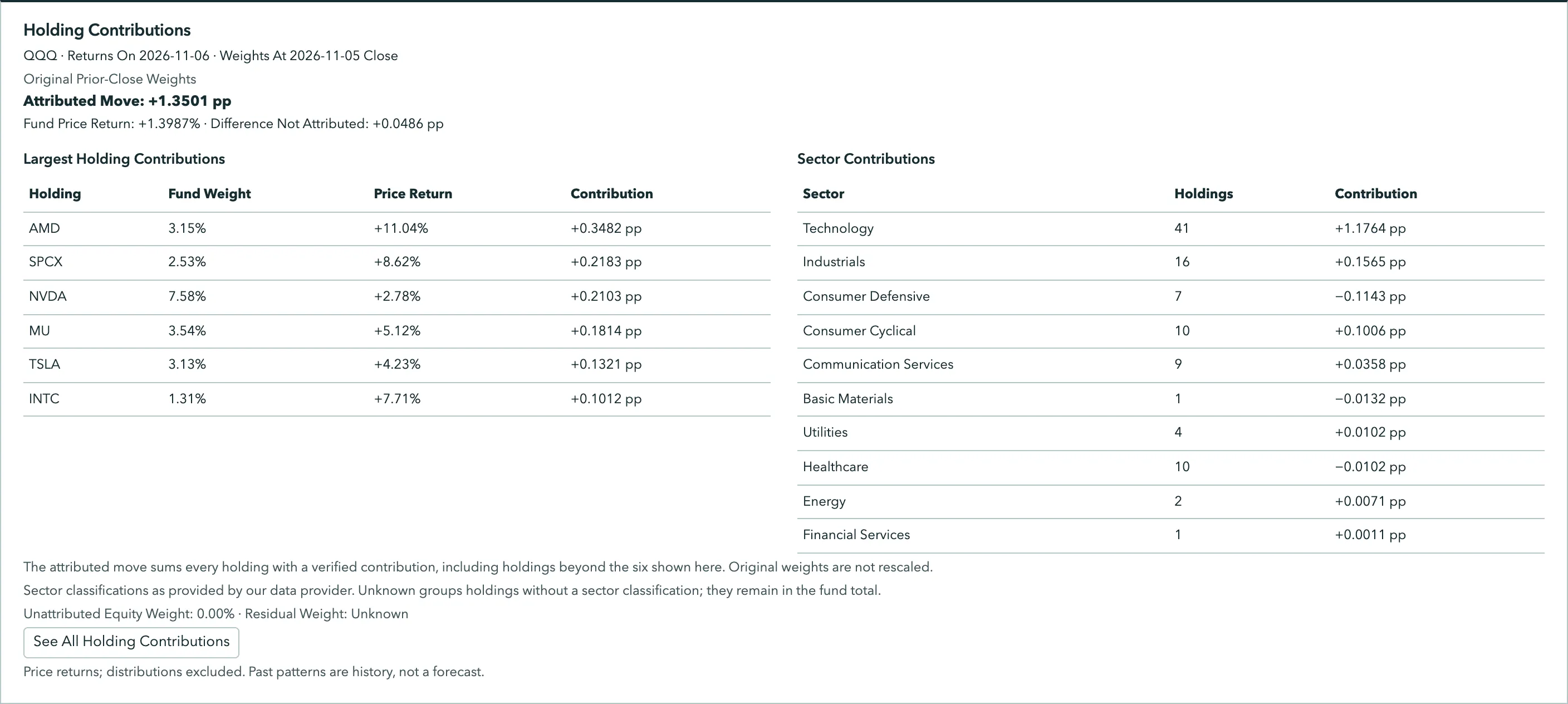
The dashboard's Holding Contributions panel for QQQ — returns on 2026-11-06, weights at the 2026-11-05 close — attributes +1.3501 points of the fund's +1.3987% to its holdings: AMD (3.15% weight, +11.04%) +0.3482 points, SPCX +0.2183, NVIDIA (7.58% weight, +2.78%) +0.2103, Micron +0.1814, Tesla +0.1321 and Intel +0.1012, six names for about 88% of the attributed move by our arithmetic, while Microsoft (-0.0684) and Apple (-0.0455) were drags. The 41 Technology holdings supplied +1.1764 points in total. QQQ's gain was a technology rebound carried mostly by chip and AI names, while Apple and Microsoft detracted; SPY's panel was unavailable.
Market history: a 5.6% dip for SPY, a 13.6% correction for QQQ
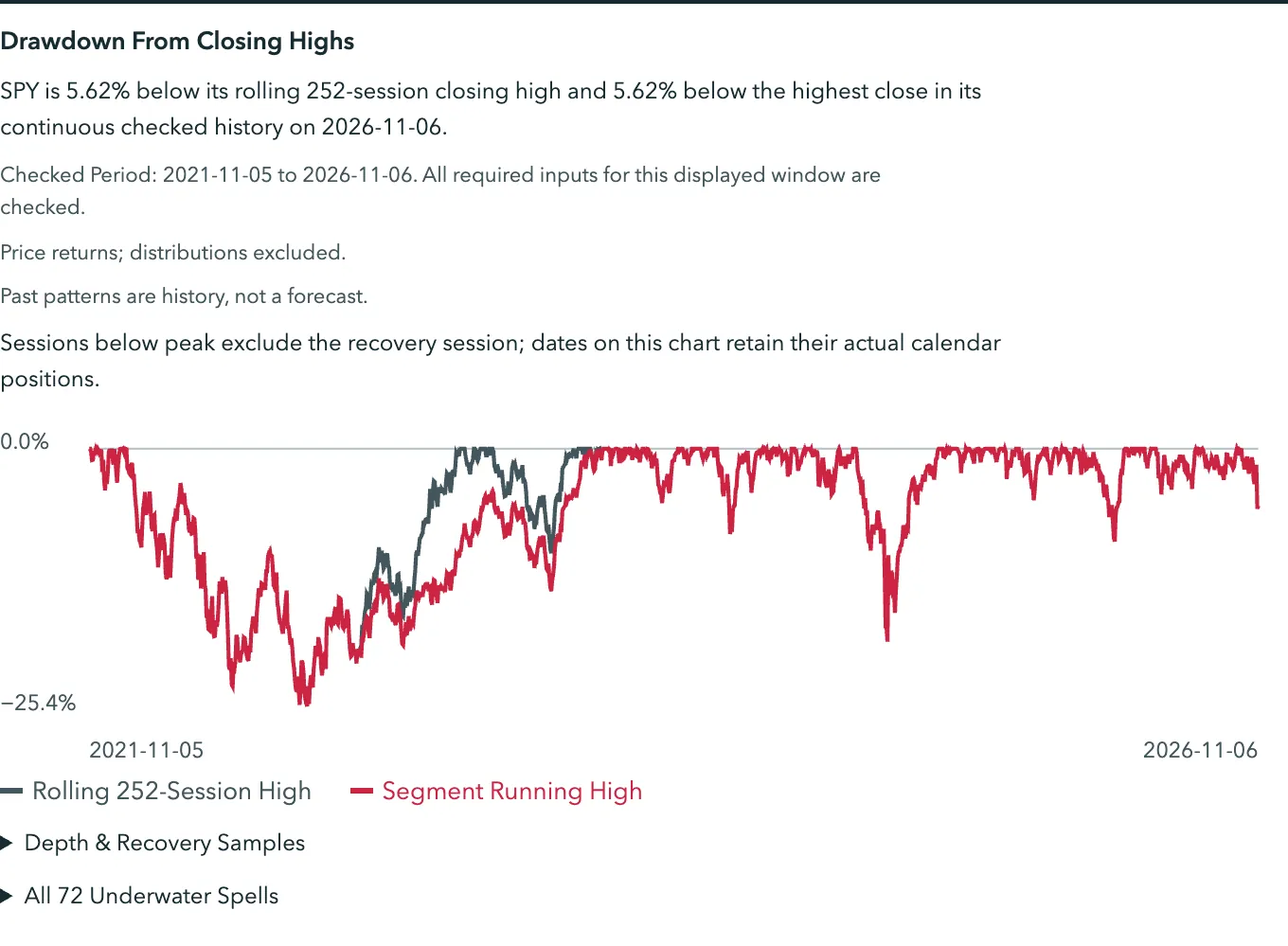
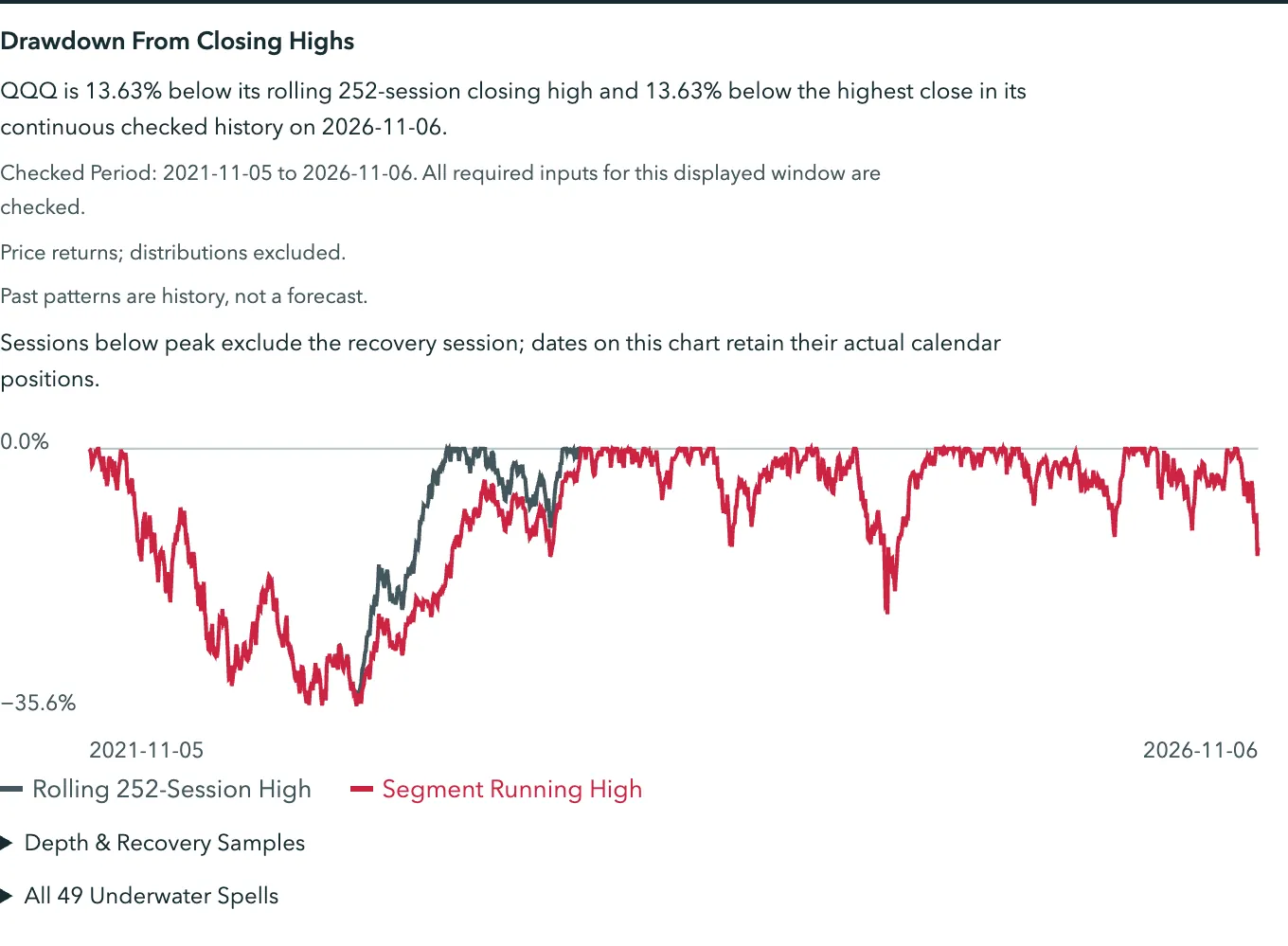
SPY closed 5.62% below its October 6 closing high of $779.09, 23 sessions in; the five-year chart's deepest trough was -25.4%. QQQ is 13.63% below its $759.66 peak against a five-year worst of -35.6%. Over twelve months SPY returned 9.69% while an equal-weight basket of 474 of its 503 members returned 18.47%; QQQ returned 7.26% against 23.78% for a basket of 91 of its 101 members. QQQ's decline is a proper correction, and the gap to the baskets says the pain is in the mega-cap growth that dominates the weights, not in the average stock.
Macro: the panel is thin, the news is loud
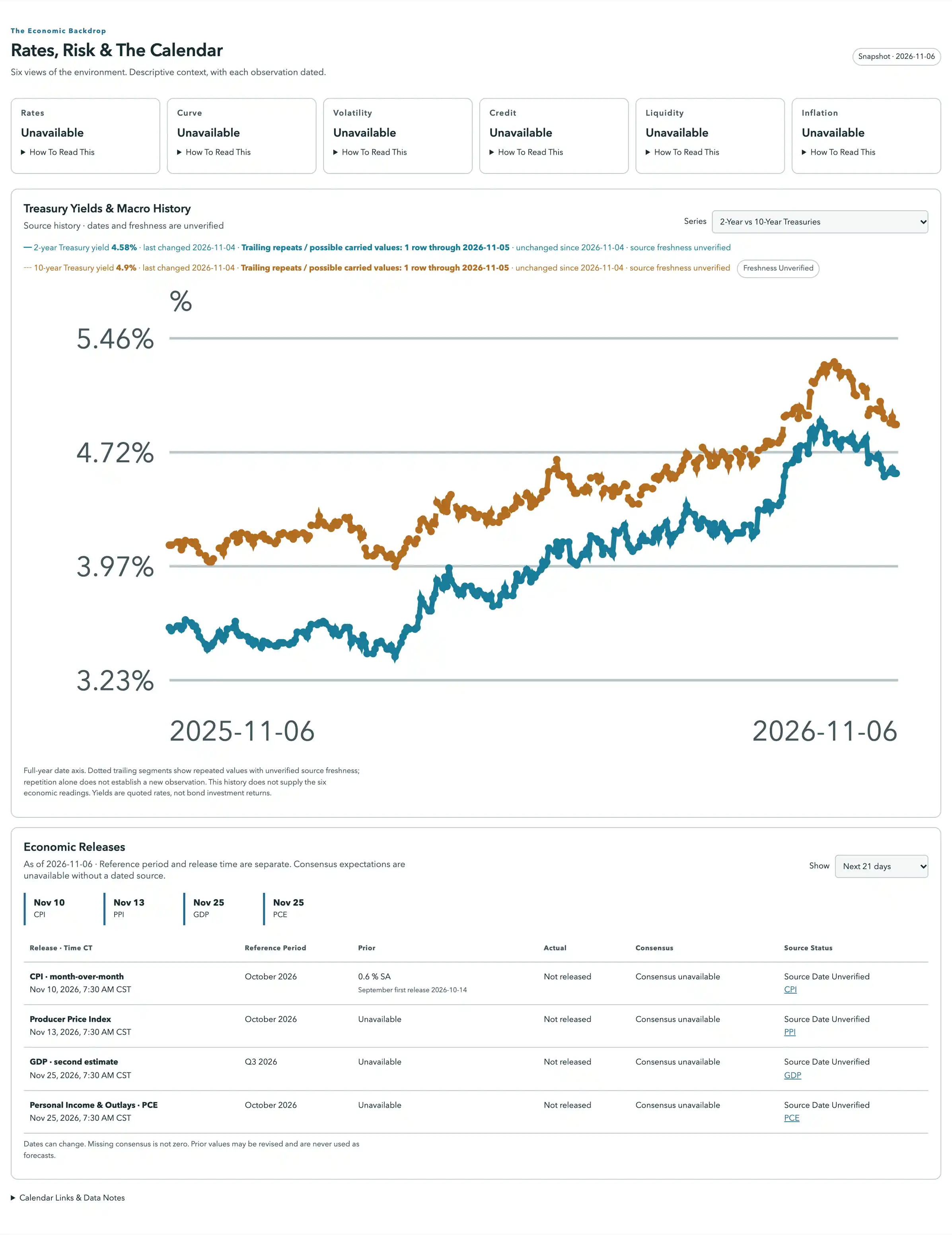
The macro module's six tiles all read Unavailable and its yield lines (2-year 4.58%, 10-year 4.9%) are carried values of unverified freshness. The official jobs report showed October payrolls +165,000 and unemployment 4.1%; Reuters (via Investing.com) reported a beat against a roughly 65,000 consensus, the 2-year up about 6 bp to 4.52%, the 10-year up about 3 bp to 4.87%, and December rate-hike odds rising to 78% from 70%; the Treasury's par curve closed at 4.51% and 4.86%. Friday's equity bounce coincided with yields and hike odds rising; the S&P 500 and Nasdaq closed higher despite the stronger-than-expected jobs report. Tuesday's CPI is the first real test; September's reported +0.6% monthly and 3.7% annual headline is the comparison.
Investing and performance: what a steady plan looked like
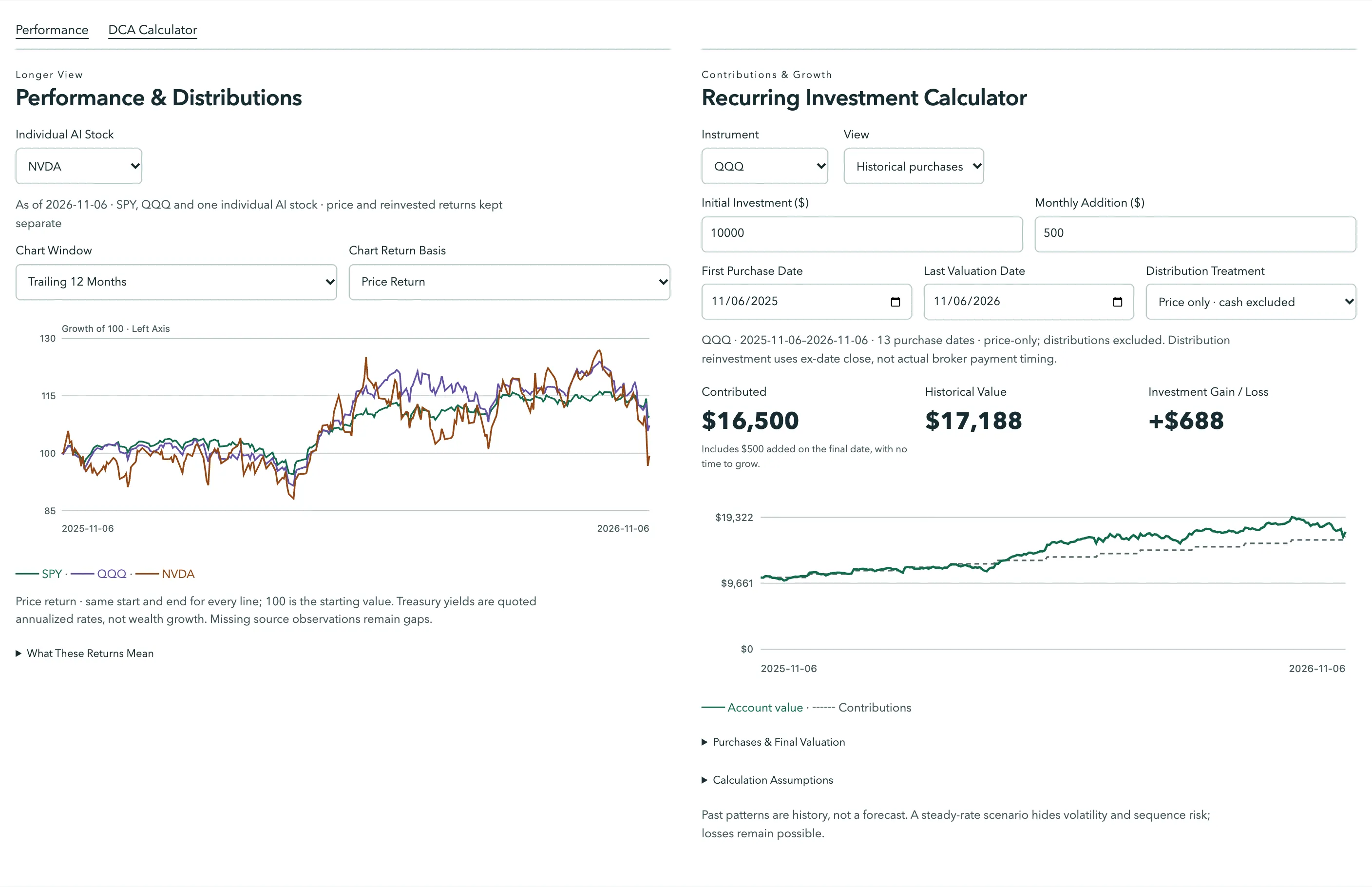
The recurring-investment panel shows $10,000 plus $500 a month into QQQ from November 6, 2025 — 13 purchases, price only — at $16,500 contributed and $17,188 of value, a gain of $688 after a 13.6% correction. On the growth-of-100 chart QQQ trails SPY over the year and the single AI stock shown (NVIDIA) has given back most of its lead. Steady buying softens the drawdown math; concentration in one theme does the opposite.
Outlook
These are scenarios with conditions, not predictions, and the weights are our subjective leanings. All three are defined over the five sessions through Friday, November 13, so exactly one will have happened.
Bear — "the broad market joins in" (about 30%). SPY closes below its 200-day ($730.38) on any day, or QQQ closes below Thursday's $647.05. We would expect that to arrive with fewer than 40% of S&P members advancing, the share above the 200-day under 50% and new lows beyond single digits; a hot CPI would fit the picture.
Bull — "Thursday was the climax" (about 25%). Neither bear trigger fires; SPY closes Friday, November 13 above its November 6 high of $742.21 and QQQ above its November 6 high of $664.52; and at least one session in between has more than 60% of S&P members advancing with a positive median stock (October 29 had 80.5%, November 4 had 74.7%). That would open the path back toward $766.81 for SPY and the 200-day at $680.89 for QQQ.
Base — "chop into NVIDIA" (about 45%). Everything else: SPY holds its 200-day but the bull conditions are not all met; oversold bounces alternate with selling, sector leadership flips daily, dispersion stays high, and the market waits for CPI, PPI and NVIDIA.
Before turning constructive we would want: a broad up day (more than 60% of S&P members advancing with a positive median); SPY above its 200-day all week and no new QQQ closing low; fund RSI back into the 40s; CPI passing without a jump in hike odds; and NVIDIA on November 17 confirming that supplier demand is intact.
Warning signs that would strengthen the case for caution: a SPY close below $730.38; fewer than 50% of S&P stocks above their 200-day; a QQQ close below $647.05; the 10-year back above 5%.
Dip, wait, or neither? In our view the evidence so far describes a correction concentrated in one theme rather than a market-wide breakdown: the S&P index and 55.8% of its members remain above their 200-day averages. For concentrated AI and semiconductor exposure, Friday was one narrow, fading bounce; dip-buyers would want the signposts above before treating it as a buyable low. Net: wait-and-see, with SPY's 200-day as the line that would change our reading.
Key dates (compiled November 9; times ET; dates can change; † = regular cadence, tentative or unverified): Tue Nov 10, 08:30 — October CPI. Wed Nov 11 — Veterans Day: stocks open; bond market close recommended (SIFMA); no data. Thu Nov 12 — jobless claims†; Cisco and Applied Materials after the close. Fri Nov 13, 08:30 — October PPI. Tue Nov 17 — retail sales; Home Depot before the open; NVIDIA after the close (about 16:20). Wed Nov 18 — FOMC minutes 14:00. Wed Nov 25† — Q3 GDP second estimate and October PCE (macro panel listing; unconfirmed).
Scorecard
This is the first entry, so there is nothing to grade yet. From tomorrow each prior outlook is graded against what the market did — the stance, the levels ($730.38 for SPY; $647.05 and $680.89 for QQQ), the breadth conditions and which scenario occurred — using the structured calls saved with this post.
Final summary
- SPY's 200-day at $730.38. A close below it would, in our view, shift this correction from sector-specific toward market-wide.
- Breadth on the next up day. More than 60% of S&P members advancing with a positive median is confirmation; another green index over a red majority is not.
- Tuesday's CPI, then NVIDIA on the 17th. In our view the rate path sets the pressure on growth valuations; NVIDIA tests whether the AI demand story survived the repricing.
Sources: Employment Situation report, Nov 6 · Reuters via Investing.com, Nov 6 · La Nacion wire wrap, Nov 6 · US Treasury daily par yield curve · September CPI report